




When it comes to bridging the divide between abstract concepts and tangible impacts, visual storytelling is one of the most powerful tools we have to engage people with our ideas. As far back as cave paintings, visual stories have been a cornerstone of communicating human values, deepening understanding, building empathy, and shaping our culture.
Fast forward a few thousand years, and digital storytelling is the new cave painting. We’re saturated with content. We have shorter attention spans. Cross-cultural connections and communication around the globe are the norm. And in this world, video, animation, and motion design give communicators powerful visual tools to make ideas more meaningful and memorable, ultimately helping people to carry them forward.
The sophistication of today’s world raises important questions. How do we visually explain complex, nuanced ideas without oversimplifying them? How do we quickly—and ethically—visualize social challenges without reinforcing the very stereotypes we want to dismantle? And how can we effectively help audiences move from understanding into action?
FrameWorks Institute has been leading research into cultural mindsets for decades, building a rich, accumulated library of information, evidence, and ideas. For their most recent research initiative, we collaborated to create Mindsets & Movements—a dynamic video motion graphic series and social media campaign that uses ethical visual storytelling to dive deep into how Americans understand and act on the essential mindsets of Individualism, Otherism, and Fatalism.
In this article, we’ll walk through how we embraced these challenges with FrameWorks to develop a visual storytelling strategy that activates their research on cultural mindsets in America to shift dominant narratives, reframe how people communicate about the ways mindsets influence our lives, and make the conversations and actions connected to them more productive.
Collaborative Storyboarding to Structure the Narrative
FrameWorks’s team came to us with fully developed scripts and studio footage, along with annotated drafts that suggested where visuals might help clarify or reinforce the speaker’s narration. From there, our team brought the concepts to life through visual design, typography, and motion graphics. But first, we started our process with collaborative storyboarding led by our Senior Designer, Doug Knapton. Doug’s approach began with static frame-by-frame mockups paired with notes describing how each moment would animate on screen.
These storyboard frames served as a shared language between our design team and FrameWorks’s communications and research staff, allowing us to map out visual components, align on the overall direction, and ensure clarity of the concept being communicated. From there, we worked iteratively across all five videos. Storyboarding was especially valuable in identifying where animation could elevate a moment or where it might be distracting. Ranging from three to five minutes, these videos had to not only educate the audience on complex topics but also engage viewers in a way that wasn’t overwhelming or jarring.
Design Strategy to Visualize Complicated Social Science and Abstract Concepts
Early conversations with the client helped us align on the larger creative direction for how the video series would interact with FrameWorks’s existing design system and extend into its other channels. Having previously partnered with FrameWorks Institute on their brand refresh and website redesign, we had a solid design foundation to build from. The goal of the FWI website is to convey the rigor of the organization’s research with a more muted, subdued color palette and editorial approach. For this series, we aimed to evolve the visual language, creating an engaging experience for social and marketing while staying within the brand guidelines. To ensure consistency, we adapted the established brand system by evolving the subdued color palette into more saturated hues that would pop on screen and keep viewers engaged for the entirety of the video series.
To bring this visual language to life, we needed a system that could help viewers grasp complex ideas. What makes cultural mindsets so important is that they are so widely shared. Everyone accesses and experiences them. When it comes to explaining them, as FrameWork’s Director of Communications, Carinne Wheeden, explains, “The goal isn’t to say any mindset is wrong—it’s about understanding how to foreground or background them through strategic communication.”
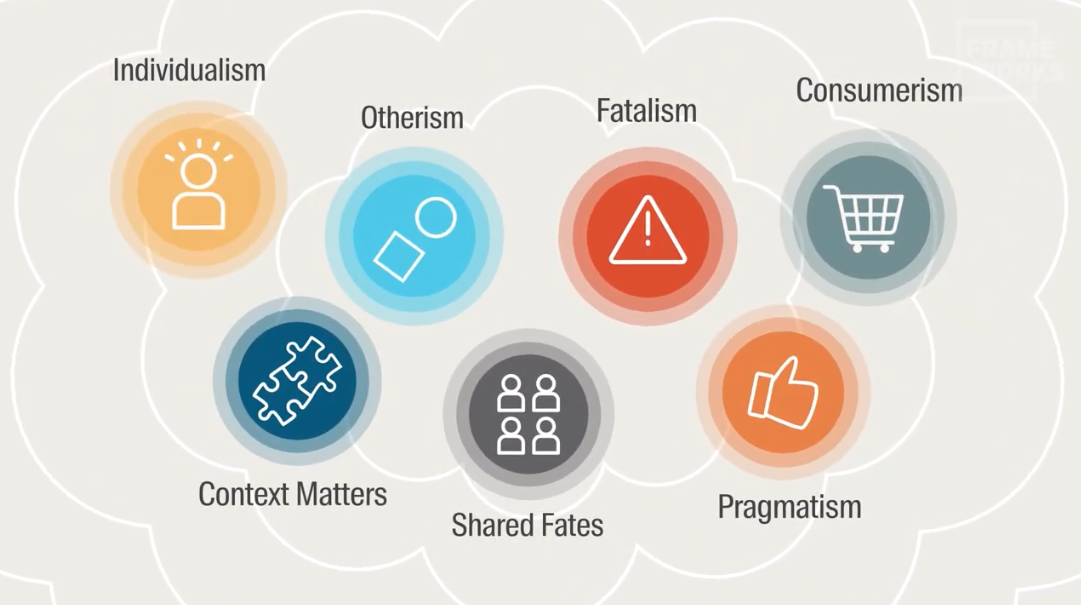
At the heart of our visual strategy was the need to communicate that the cultural mindsets of Individualism, Otherism, and Fatalism aren’t just individual beliefs but are widely shared and systemic. We developed a set of animated visual motifs to reinforce this idea: shapes that ripple outward and grow bigger when highlighted to allude to their pervasiveness and wide-reaching impacts. We intentionally developed symbolic, color-coded icons—yellow for Individualism, blue for Otherism, and red for Fatalism—to give the FWI team a consistent visual shorthand for use across presentations, reports, and future videos. These new icons, along with a system of animated shapes, metaphors, and thematic color palettes, provide flexible tools for visual storytelling that maintain clarity and consistency.

Ethical Visual Storytelling That Shifts to More Productive Narratives
The research that FrameWorks shares is often complex, abstract, and by nature, not inherently visual. And when it is visual, there’s a real risk of unintentionally reinforcing the same stereotypes and misconceptions their work seeks to dismantle. Throughout the process of designing this video series, we carefully scrutinized every image, icon, and animation to ensure it aligned with their mission and communicated the core concept without bias or misrepresentation.
We asked ourselves: Would it mislead? Reinforce a bias? Oversimplify a system? We worked to avoid reductive representations, especially around topics like race, poverty, and health. When considering the inclusion of people’s photos, we discussed how facial expressions could easily veer into cliché or stereotype. Instead, we leaned into abstraction and metaphor, creating visual motifs that encourage reflection. For example, we explored how to convey concepts like the savoir complex or structural racism without flattening them into a single image. Equally important were the decisions made about what not to show. There were moments where we deliberately used typography, narration, or negative space in place of visuals. By doing so, we avoided forced imagery that might be reductive and let the speaker truly speak for themselves. Knowing when to show versus tell became a guiding principle across the series.
Motion as Meaning: Activating Ideas With Engaging Animation
While storyboarding and visual design were essential to shaping the narrative, it was the animation that truly brought the experience to life. Combining studio interview footage with custom motion graphics, we created a dynamic play between spoken word and visual metaphor. Each transition, sequence, and visual cue was carefully calibrated to support the script’s narrative arc and set a pace that maintained momentum. We also focused on the dynamic between speakers and visuals, ensuring they worked together instead of competing for attention.
Translating our static storyboards into animation revealed unique challenges throughout the process. Some metaphors worked better in motion, while others lost their effectiveness. As Doug explains, “I had to break down the voiceover word by word to get the timing just right. Sometimes too much motion overwhelmed the message.” We iterated closely with the client throughout the process, ensuring each visual sequence aligned with the pacing of the speakers while supporting the narrative’s overall arc. The end result is a seamless flow between expert voiceover, time on screen, and conceptual visualization that deepens understanding and strengthens impact. Animation became the connective thread that tied together framing science, expert voices, and the audience’s viewing experience.
See the Work
This project demonstrates what’s possible when communicators, researchers, and designers work together to translate complex research into accessible and actionable content. We leaned into each other’s expertise, challenged assumptions, and emerged with new perspectives. This video series clearly communicates FrameWorks Institute’s extensive research and equips advocates, communicators, and policymakers with tools to better tell their stories and shape productive public narratives.
Partner with Constructive to use video, motion design, and visual storytelling to translate complex content into engaging experiences!
